


Portal:Computer programming

The Computer Programming Portal

Computer programming or coding is the composition of sequences of instructions, called programs, that computers can follow to perform tasks. It involves designing and implementing algorithms, step-by-step specifications of procedures, by writing code in one or more programming languages. Programmers typically use high-level programming languages that are more easily intelligible to humans than machine code, which is directly executed by the central processing unit. Proficient programming usually requires expertise in several different subjects, including knowledge of the application domain, details of programming languages and generic code libraries, specialized algorithms, and formal logic.
Auxiliary tasks accompanying and related to programming include analyzing requirements, testing, debugging (investigating and fixing problems), implementation of build systems, and management of derived artifacts, such as programs' machine code. While these are sometimes considered programming, often the term software development is used for this larger overall process – with the terms programming, implementation, and coding reserved for the writing and editing of code per se. Sometimes software development is known as software engineering, especially when it employs formal methods or follows an engineering design process. (Full article...)
Selected articles -
-
![Image 1 Ada is a structured, statically typed, imperative, and object-oriented high-level programming language, inspired by Pascal and other languages. It has built-in language support for design by contract (DbC), extremely strong typing, explicit concurrency, tasks, synchronous message passing, protected objects, and non-determinism. Ada improves code safety and maintainability by using the compiler to find errors in favor of runtime errors. Ada is an international technical standard, jointly defined by the International Organization for Standardization (ISO), and the International Electrotechnical Commission (IEC). As of May 2023[update], the standard, ISO/IEC 8652:2023, is called Ada 2022 informally. Ada was originally designed by a team led by French computer scientist Jean Ichbiah of Honeywell under contract to the United States Department of Defense (DoD) from 1977 to 1983 to supersede over 450 programming languages then used by the DoD. Ada was named after Ada Lovelace (1815–1852), who has been credited as the first computer programmer. (Full article...)](/proxy/https%3A%2F%2Fupload.wikimedia.org%2Fwikipedia%2Fen%2Fd%2Fd2%2FBlank.png)

Ada is a structured, statically typed, imperative, and object-oriented high-level programming language, inspired by Pascal and other languages. It has built-in language support for design by contract (DbC), extremely strong typing, explicit concurrency, tasks, synchronous message passing, protected objects, and non-determinism. Ada improves code safety and maintainability by using the compiler to find errors in favor of runtime errors. Ada is an international technical standard, jointly defined by the International Organization for Standardization (ISO), and the International Electrotechnical Commission (IEC). As of May 2023[update], the standard, ISO/IEC 8652:2023, is called Ada 2022 informally.
Ada was originally designed by a team led by French computer scientist Jean Ichbiah of Honeywell under contract to the United States Department of Defense (DoD) from 1977 to 1983 to supersede over 450 programming languages then used by the DoD. Ada was named after Ada Lovelace (1815–1852), who has been credited as the first computer programmer. (Full article...) -
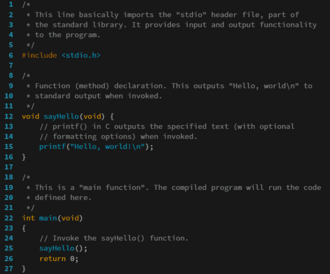
The source code for a computer program in C. The gray lines are comments that explain the program to humans. When compiled and run, it will give the output "Hello, world!".
A programming language is an engineered language for expressing computer programs.
Programming languages typically allow software to be written in a human readable manner.
Execution of a program requires an implementation. There are two main approaches for implementing a programming language – compilation, where programs are compiled ahead-of-time to machine code, and interpretation, where programs are directly executed. In addition to these two extremes, some implementations use hybrid approaches such as just-in-time compilation and bytecode interpreters. (Full article...) -
Linus Benedict Torvalds (born 28 December 1969) is a Finnish and American software engineer who is the creator and lead developer of the Linux kernel since 1991. He also created the distributed version control system Git.
Torvalds was one of the recipients of the 2012 Millennium Technology Prize "in recognition of his creation of a new open source operating system for computers leading to the widely used Linux kernel". He is also the recipient of the 2014 IEEE Computer Society Computer Pioneer Award and the 2018 IEEE Masaru Ibuka Consumer Electronics Award. (Full article...) -
Prolog is a logic programming language that has its origins in artificial intelligence, automated theorem proving, and computational linguistics.
Prolog has its roots in first-order logic, a formal logic. Unlike many other programming languages, Prolog is intended primarily as a declarative programming language: the program is a set of facts and rules, which define relations. A computation is initiated by running a query over the program.
Prolog was one of the first logic programming languages and remains the most popular such language today, with several free and commercial implementations available. The language has been used for theorem proving, expert systems, term rewriting, type systems,, automated planning,, and question answering as well as its original intended field of use, natural language processing. (Full article...) -

F# (pronounced F sharp) is a general-purpose, high-level, strongly typed, multi-paradigm programming language that encompasses functional, imperative, and object-oriented programming methods. It is most often used as a cross-platform Common Language Infrastructure (CLI) language on .NET, but can also generate JavaScript and graphics processing unit (GPU) code.
F# is developed by the F# Software Foundation, Microsoft and open contributors. An open source, cross-platform compiler for F# is available from the F# Software Foundation. F# is a fully supported language in Visual Studio and JetBrains Rider. Plug-ins supporting F# exist for many widely used editors including Visual Studio Code, Vim, and Emacs.
F# is a member of the ML language family and originated as a .NET Framework implementation of a core of the programming language OCaml. It has also been influenced by C#,
Python, Haskell, Scala and Erlang. (Full article...) -
In C++ computer programming, allocators are a component of the C++ Standard Library. The standard library provides several data structures, such as list and set, commonly referred to as containers. A common trait among these containers is their ability to change size during the execution of the program. To achieve this, some form of dynamic memory allocation is usually required. Allocators handle all the requests for allocation and deallocation of memory for a given container. The C++ Standard Library provides general-purpose allocators that are used by default; however, custom allocators may also be supplied by the programmer.
Allocators were invented by Alexander Stepanov as part of the Standard Template Library (STL). They were originally intended as a means to make the library more flexible and independent of the underlying memory model, allowing programmers to utilize custom pointer and reference types with the library. However, in the process of adopting STL into the C++ standard, the C++ standardization committee realized that a complete abstraction of the memory model would incur unacceptable performance penalties. To remedy this, the requirements of allocators were made more restrictive. As a result, the level of customization provided by allocators is more limited than was originally envisioned by Stepanov.
Nevertheless, there are many scenarios where customized allocators are desirable. Some of the most common reasons for writing custom allocators include improving performance of allocations by using memory pools, and encapsulating access to different types of memory, like shared memory or garbage-collected memory. In particular, programs with many frequent allocations of small amounts of memory may benefit greatly from specialized allocators, both in terms of running time and memory footprint. (Full article...) -
Swift is a high-level general-purpose, multi-paradigm, compiled programming language created by Chris Lattner in 2010 for Apple Inc. and maintained by the open-source community. Swift compiles to machine code and uses an LLVM-based compiler. Swift was first released in June 2014 and the Swift toolchain has shipped in Xcode since Xcode version 6, released in September 2014.
Apple intended Swift to support many core concepts associated with Objective-C, notably dynamic dispatch, widespread late binding, extensible programming, and similar features, but in a "safer" way, making it easier to catch software bugs; Swift has features addressing some common programming errors like null pointer dereferencing and provides syntactic sugar to help avoid the pyramid of doom. Swift supports the concept of protocol extensibility, an extensibility system that can be applied to types, structs and classes, which Apple promotes as a real change in programming paradigms they term "protocol-oriented programming" (similar to traits and type classes).
Swift was introduced at Apple's 2014 Worldwide Developers Conference (WWDC). It underwent an upgrade to version 1.2 during 2014 and a major upgrade to Swift 2 at WWDC 2015. It was initially a proprietary language, but version 2.2 was made open-source software under the Apache License 2.0 on December 3, 2015, for Apple's platforms and Linux. (Full article...) -
Yoshua Bengio OC OQ OBE FRS FRSC (born March 5, 1964) is a Canadian computer scientist, and a pioneer of artificial neural networks and deep learning. He is a professor at the Université de Montréal and co-president and scientific director of the nonprofit LawZero. He founded Mila, the Quebec Artificial Intelligence (AI) Institute, and was its scientific director until 2025.
Bengio received the 2018 ACM A.M. Turing Award, often referred to as the "Nobel Prize of Computing", together with Geoffrey Hinton and Yann LeCun, for their foundational work on deep learning. Bengio, Hinton, and LeCun are sometimes referred to as the "Godfathers of AI". Bengio is the most-cited computer scientist globally (by both total citations and by h-index), and the most-cited living scientist across all fields (by total citations). In November 2025, Bengio became the first AI researcher with more than a million Google Scholar citations. In 2024, TIME Magazine included Bengio in its yearly list of the world's 100 most influential people. (Full article...) -
MATLAB (Matrix Laboratory) is a proprietary multi-paradigm programming language and numeric computing environment developed by MathWorks. MATLAB allows matrix manipulations, plotting of functions and data, implementation of algorithms, creation of user interfaces, and interfacing with programs written in other languages.
Although MATLAB is intended primarily for numeric computing, an optional toolbox uses the MuPAD symbolic engine allowing access to symbolic computing abilities. An additional package, Simulink, adds graphical multi-domain simulation and model-based design for dynamic and embedded systems.
As of 2020[update], MATLAB has more than four million users worldwide. They come from various backgrounds of engineering, science, and economics. As of 2017[update], more than 5000 global colleges and universities use MATLAB to support instruction and research. (Full article...) -

Portion of the calculating machine with a printing mechanism of the analytical engine, built by Charles Babbage, as displayed at the Science Museum (London)
The analytical engine was a proposed digital mechanical general-purpose computer designed by the English mathematician and computer pioneer Charles Babbage. It was first described in 1837 as the successor to Babbage's difference engine, which was a design for a simpler mechanical calculator.
The analytical engine incorporated an arithmetic logic unit, control flow in the form of conditional branching and loops, and integrated memory, making it the first design for a general-purpose computer that could be described in modern terms as Turing-complete. In other words, the structure of the analytical engine was essentially the same as that which has dominated computer design in the electronic era. The analytical engine is one of the most successful achievements of Charles Babbage.
Babbage was never able to complete construction of any of his machines due to conflicts with his chief engineer and inadequate funding. It was not until 1941 that Konrad Zuse built the first general-purpose computer, Z3, more than a century after Babbage had proposed the pioneering analytical engine in 1837. (Full article...) -

Scala (/ˈskɑːlɑː/ SKAH-lah) is a strongly statically typed high-level general-purpose programming language that supports both object-oriented programming and functional programming. Designed to be concise, many of Scala's design decisions are intended to address criticisms of Java.
Scala source code can be compiled to Java bytecode and run on a Java virtual machine (JVM). Scala can also be transpiled to JavaScript to run in a browser, or compiled directly to a native executable using Clang. When running on the JVM, Scala provides language interoperability with Java so that libraries written in either language may be referenced directly in Scala or Java code. Like Java, Scala is object-oriented, and uses a syntax termed curly-brace which is similar to the language C. Since Scala 3, there is also an option to use the off-side rule (indenting) to structure blocks, and its use is advised. Martin Odersky has said that this turned out to be the most productive change introduced in Scala 3.
Unlike Java, Scala has many features of functional programming languages (like Scheme, Standard ML, and Haskell), including currying, immutability, lazy evaluation, and pattern matching. It also has an advanced type system supporting algebraic data types, covariance and contravariance, higher-order types (but not higher-rank types), anonymous types, operator overloading, optional parameters, named parameters, raw strings, and an experimental exception-only version of algebraic effects that can be seen as a more powerful version of Java's checked exceptions. (Full article...) -

W3sDesign Interpreter Design Pattern UML
In computing, an interpreter is software that executes source code without first compiling it to machine code. An interpreted runtime environment differs from one that processes CPU-native executable code which requires translating source code before executing it. An interpreter may translate the source code to an intermediate format, such as bytecode. A hybrid environment may translate the bytecode to machine code via just-in-time compilation, as in the case of .NET and Java, instead of interpreting the bytecode directly.
Before the widespread adoption of interpreters, the execution of computer programs often relied on compilers, which translate and compile source code into machine code. Early runtime environments for Lisp and BASIC could parse source code directly. Thereafter, runtime environments were developed for languages (such as Perl, Raku, Python, MATLAB, and Ruby), which translated source code into an intermediate format before executing to enhance runtime performance.
Code that runs in an interpreter can be run on any platform that has a compatible interpreter. The same code can be distributed to any such platform, instead of an executable having to be built for each platform. Although each programming language is usually associated with a particular runtime environment, a language can be used in different environments. Interpreters have been constructed for languages traditionally associated with compilation, such as ALGOL, Fortran, COBOL, C and C++. (Full article...) -
Computer programming or coding is the composition of sequences of instructions, called programs, that computers can follow to perform tasks. It involves designing and implementing algorithms, step-by-step specifications of procedures, by writing code in one or more programming languages. Programmers typically use high-level programming languages that are more easily intelligible to humans than machine code, which is directly executed by the central processing unit. Proficient programming usually requires expertise in several different subjects, including knowledge of the application domain, details of programming languages and generic code libraries, specialized algorithms, and formal logic.
Auxiliary tasks accompanying and related to programming include analyzing requirements, testing, debugging (investigating and fixing problems), implementation of build systems, and management of derived artifacts, such as programs' machine code. While these are sometimes considered programming, often the term software development is used for this larger overall process – with the terms programming, implementation, and coding reserved for the writing and editing of code per se. Sometimes software development is known as software engineering, especially when it employs formal methods or follows an engineering design process. (Full article...) -
The Antikythera mechanism (/ˌæntɪkɪˈθɪərə/ AN-tik-ih-THEER-ə, US also /ˌæntaɪkɪˈ-/ AN-ty-kih-) is an ancient Greek hand-powered orrery (model of the Solar System). It is the oldest known example of an analogue computer. It could be used to predict astronomical positions and eclipses decades in advance. It could also be used to track the four-year cycle of athletic games similar to an olympiad, the cycle of the ancient Olympic Games.
The artefact was among wreckage retrieved from a shipwreck off the coast of the Greek island Antikythera in 1901. In 1902, during a visit to the National Archaeological Museum in Athens, it was noticed by Greek politician Spyridon Stais as containing a gear, prompting the first study of the fragment by his cousin, Valerios Stais, the museum director. The device, housed in the remains of a wooden-framed case of (uncertain) overall size 34 cm × 18 cm × 9 cm (13.4 in × 7.1 in × 3.5 in), was found as one lump, later separated into three main fragments which are now divided into 82 separate fragments after conservation efforts. Four of these fragments contain gears, while inscriptions are found on many others. The largest gear is about 13 cm (5 in) in diameter and originally had 223 teeth. All these fragments of the mechanism are kept at the National Archaeological Museum, along with reconstructions and replicas, to demonstrate how it may have looked and worked.
In 2005, a team from Cardiff University led by Mike Edmunds used computer X-ray tomography and high resolution scanning to image inside fragments of the crust-encased mechanism and read faint inscriptions that once covered the outer casing. These scans suggest that the mechanism had 37 meshing bronze gears enabling it to follow the movements of the Moon and the Sun through the zodiac, to predict eclipses and to model the irregular orbit of the Moon, where the Moon's velocity is higher in its perigee than in its apogee. This motion was studied in the 2nd century BC by astronomer Hipparchus of Rhodes, and he may have been consulted in the machine's construction. There is speculation that a portion of the mechanism is missing and it calculated the positions of the five classical planets. The inscriptions were further deciphered in 2016, revealing numbers connected with the synodic cycles of Venus and Saturn. (Full article...) -
Laboratory Virtual Instrument Engineering Workbench (LabVIEW) is a graphical system design and development platform produced and distributed by National Instruments, based on a programming environment that uses a visual programming language. It is widely used for data acquisition, instrument control, and industrial automation. It provides tools for designing and deploying complex test and measurement systems.
The visual (aka graphical) programming language is called "G" (not to be confused with G-code). It is a dataflow language originally developed by National Instruments. LabVIEW is supported on a variety of operating systems (OSs), including macOS and other versions of Unix and Linux, as well as Microsoft Windows.
The latest versions of LabVIEW are LabVIEW 2024 Q3 (released in July 2024) and LabVIEW NXG 5.1 (released in January 2021). National Instruments released the free for non-commercial use LabVIEW and LabVIEW NXG Community editions on April 28, 2020. (Full article...)
![Image 1 Ada is a structured, statically typed, imperative, and object-oriented high-level programming language, inspired by Pascal and other languages. It has built-in language support for design by contract (DbC), extremely strong typing, explicit concurrency, tasks, synchronous message passing, protected objects, and non-determinism. Ada improves code safety and maintainability by using the compiler to find errors in favor of runtime errors. Ada is an international technical standard, jointly defined by the International Organization for Standardization (ISO), and the International Electrotechnical Commission (IEC). As of May 2023[update], the standard, ISO/IEC 8652:2023, is called Ada 2022 informally. Ada was originally designed by a team led by French computer scientist Jean Ichbiah of Honeywell under contract to the United States Department of Defense (DoD) from 1977 to 1983 to supersede over 450 programming languages then used by the DoD. Ada was named after Ada Lovelace (1815–1852), who has been credited as the first computer programmer. (Full article...)](/browse?url=https%3A%2F%2Fen.wikipedia.org%2Fwiki%2FFile%3ABlank.png)


_(cropped).jpeg)


.jpg)


Selected images
-
 A view of the GNU nano Text editor version 6.0
 -
 GNOME Shell, GNOME Clocks, Evince, gThumb and GNOME Files at version 3.30, in a dark theme
 -
 Partial map of the Internet based on the January 15, 2005 data found on opte.org. Each line is drawn between two nodes, representing two IP addresses. The length of the lines are indicative of the delay between those two nodes. This graph represents less than 30% of the Class C networks reachable by the data collection program in early 2005.
 -
 Deep Blue was a chess-playing expert system run on a unique purpose-built IBM supercomputer. It was the first computer to win a game, and the first to win a match, against a reigning world champion under regular time controls. Photo taken at the Computer History Museum.
 -

-
 Animation of a Non-uniform rational B-spline surface. Modeled and rendered in Cobalt.
 -
 A head crash on a modern hard disk drive
 -
 An IBM Port-A-Punch punched card
 -
 Grace Hopper at the UNIVAC keyboard, c. 1960. Grace Brewster Murray: American mathematician and rear admiral in the U.S. Navy who was a pioneer in developing computer technology, helping to devise UNIVAC I. the first commercial electronic computer, and naval applications for COBOL (common-business-oriented language).
 -
 Ada Lovelace was an English mathematician and writer, chiefly known for her work on Charles Babbage's proposed mechanical general-purpose computer, the Analytical Engine. She was the first to recognize that the machine had applications beyond pure calculation, and to have published the first algorithm intended to be carried out by such a machine. As a result, she is often regarded as the first computer programmer.
 -
 Partial view of the Mandelbrot set. Step 1 of a zoom sequence: Gap between the "head" and the "body" also called the "seahorse valley".
 -
 A lone house. An image made using Blender 3D.
 -
 This image (when viewed in full size, 1000 pixels wide) contains 1 million pixels, each of a different color.
 -

-
 Bill Gosper's Glider Gun in action
 -
 Stephen Wolfram is a British-American computer scientist, physicist, and businessman. He is known for his work in computer science, mathematics, and in theoretical physics.
 -
 Output from a (linearised) shallow water equation model of water in a bathtub. The water experiences 5 splashes which generate surface gravity waves that propagate away from the splash locations and reflect off of the bathtub walls.
 -
 Margaret Hamilton standing next to the navigation software that she and her MIT team produced for the Apollo Project.

_in_Dark_theme.png)


Did you know? -

- ... that a "hacker" with blog posts written by ChatGPT was at the center of an online scavenger hunt promoting Avenged Sevenfold's album Life Is but a Dream...?
- ... that the study of selection algorithms has been traced to an 1883 work of Lewis Carroll on how to award second place in single-elimination tournaments?
- ... that NATO was once targeted by a group of "gay furry hackers"?
- ... that both Thackeray and Longfellow bought paintings by Fanny Steers?
- ... that the Gale–Shapley algorithm was used to assign medical students to residencies long before its publication by Gale and Shapley?
- ... that it took a particle accelerator and machine-learning algorithms to extract the charred text of PHerc. Paris. 4 without unrolling it?
Subcategories

WikiProjects

- There are many users interested in computer programming, join them.
Computer programming news
No recent news
Topics


Related portals


Associated Wikimedia
The following Wikimedia Foundation sister projects provide more on this subject:
-
 Commons
Free media repository -
 Wikibooks
Free textbooks and manuals -
 Wikidata
Free knowledge base -
 Wikinews
Free-content news -
 Wikiquote
Collection of quotations -
 Wikisource
Free-content library -
 Wikiversity
Free learning tools -
 Wiktionary
Dictionary and thesaurus


